Projects
Project
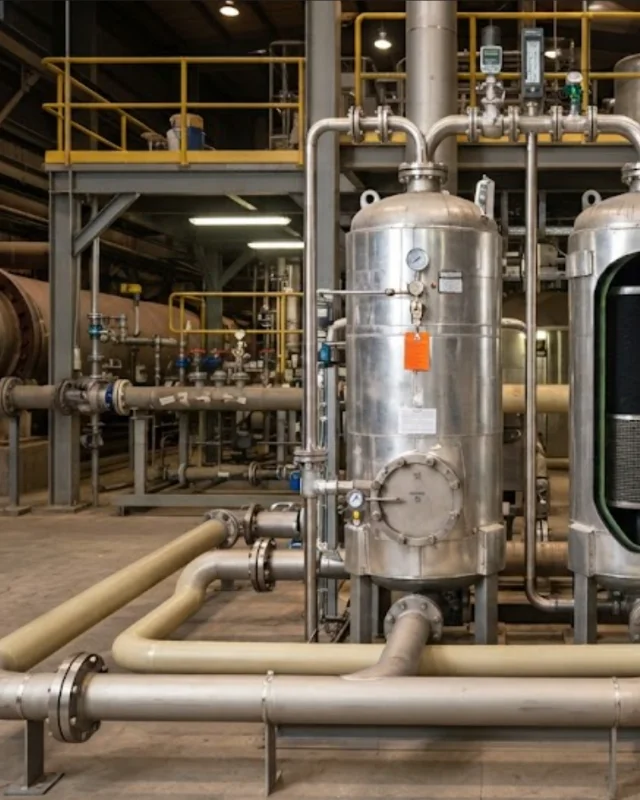
A sustainability initiative for Kemira and UPM in Fray Bentos aimed at improving hydrogen quality and reducing chlorine levels in the lime kiln feed. Technically, it involves refurbishing and upgrading the existing activated carbon filters by applying an internal FRP lining, titanium discharge piping, FRP drains, and a new water seal, while also integrating a demineralized water injection system and automated control via the Honeywell Experion system.
Scope
It covers the entire development cycle, which is divided into three main stages:
-
Basic Engineering: Preparation of process documents (PFDs, preliminary P&IDs, material balances), definition of auxiliary equipment and instrumentation, and a capital expenditure (CAPEX) estimate broken down by area with an accuracy of $pm10%$.
-
Detailed Engineering: Point cloud surveying, 3D modeling, development of construction drawings (IFC), isometric drawings, support details, bills of quantities (BOQ), and a complete update of the instrumentation, control, and loop documentation.
-
On-Site Supervision: Daily management and oversight of contractors during the construction phase; monitoring of the schedule, budget, and quality; progress reports; risk management; and preparation of the final punch list through provisional acceptance.
Impact
The project optimizes the plant’s environmental and operational performance by reducing chlorine levels through a circular economy solution (reuse of existing infrastructure). At the same time, the rigorous engineering design safely mitigates the high risk of corrosion caused by demineralized water, ensuring asset integrity, process reliability through the Honeywell system, and strict technical and economic predictability from CAPEX through project delivery.